

1. Introduction
1.1 Why this assessment is needed
Entering a carbon market requires more than an estimate of avoided or removed emissions. A case also needs a clear boundary, an eligible market route, a credible baseline, a workable monitoring plan, safeguards for people and nature, and evidence that a buyer could use the resulting units. These questions are linked. A credit volume cannot be treated as reliable if the activity or baseline is still unclear, and an NPV cannot be treated as meaningful if the proposed route cannot accept the case.
This study develops and applies one common assessment model to three very different cases. The model gives the same questions to each case while allowing the evidence and calculation method to follow the activity. It is designed for an early decision: should the company continue collecting evidence, define a more specific project, test a market route, move to financial modelling, or stop work on the proposed route?
1.2 Aim and research questions
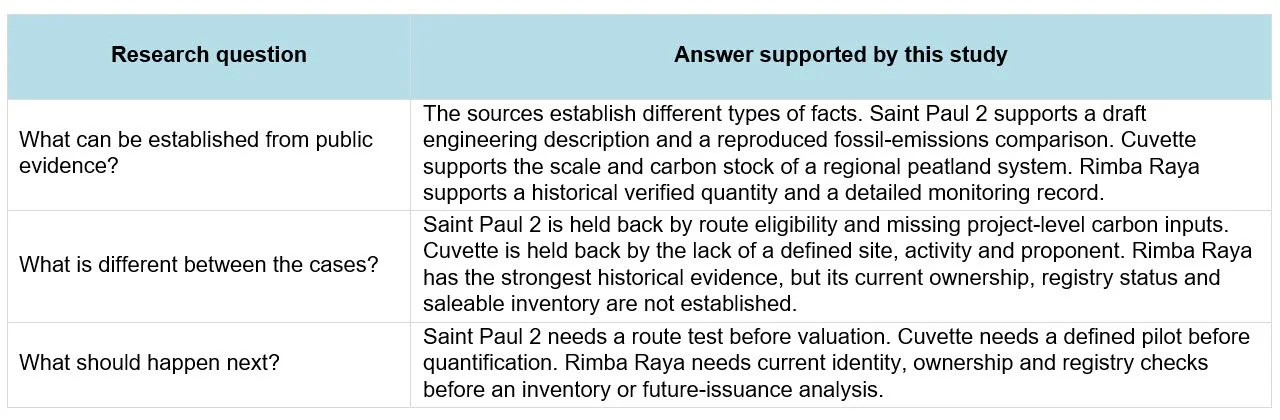
The aim is to compare the carbon-market readiness of three cases using a consistent and traceable process. The study answers three practical questions:
· What can be established from public project, scientific, registry and programme documents?
· What is different between the three cases when they are reviewed against the same eight questions?
· What is the most useful next action for each case?
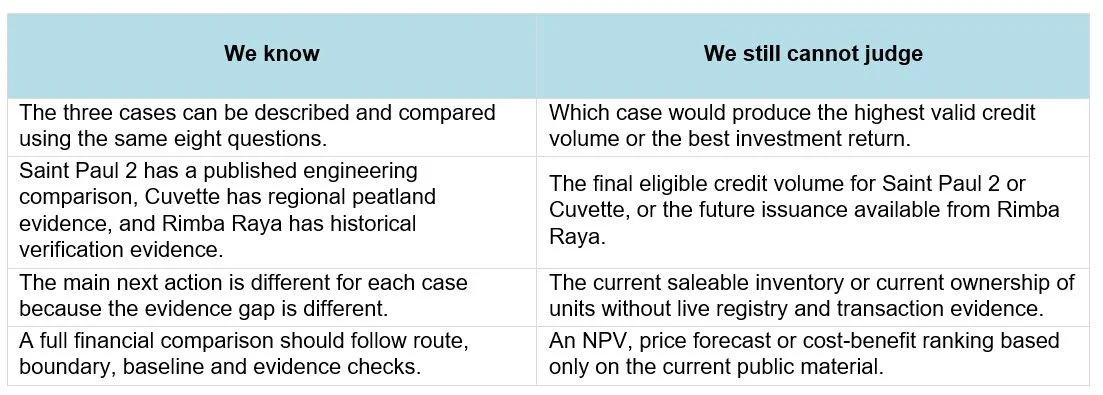
The study is a screening comparison. It does not rank the cases by NPV, predict a final credit volume, or claim that any case has a current balance of credits available for sale. Those conclusions require project-level documents and commercial inputs that are not available in the reviewed public material.
1.3 Scope and case boundaries
The word case is used throughout this paper because the three items are at different stages of definition. They are assessed within the following boundaries.
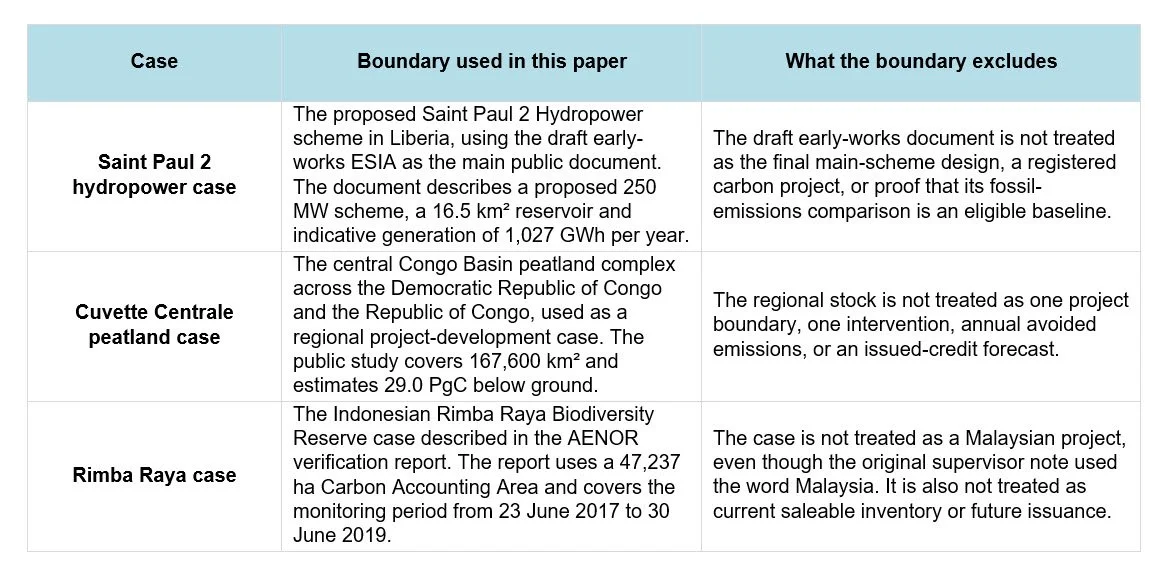
This boundary choice makes the comparison explicit. It also prevents a regional scientific estimate, a draft engineering disclosure and a historical verification report from being presented as if they were equivalent completed projects.
1.4 Decision supported by the framework
The framework supports an evidence and sequencing decision. It identifies whether a case is ready for the next stage of work and explains what must be established first. For Saint Paul 2, the immediate question is whether a suitable crediting route exists before detailed carbon valuation. For Cuvette Centrale, the immediate question is which site, activity and responsible organisation should define a pilot. For Rimba Raya, the immediate question is whether the Indonesian case in the source record is the intended case and what its current legal, registry and ownership position is.
2. Assessment Framework and Method
2.1 One model for different activities
The common model keeps the decision questions constant and allows the technical answer to change with the activity. A hydropower case needs an electricity baseline and a route test for grid-connected generation. A peatland case needs a defined intervention, a land-use counterfactual and evidence on hydrology, fire and leakage. A forest conservation case needs a mapped boundary, a deforestation baseline, monitoring records and a current review of rights and issuance. The model therefore creates comparability at the level of decision questions, rather than by forcing the same carbon formula onto every case.
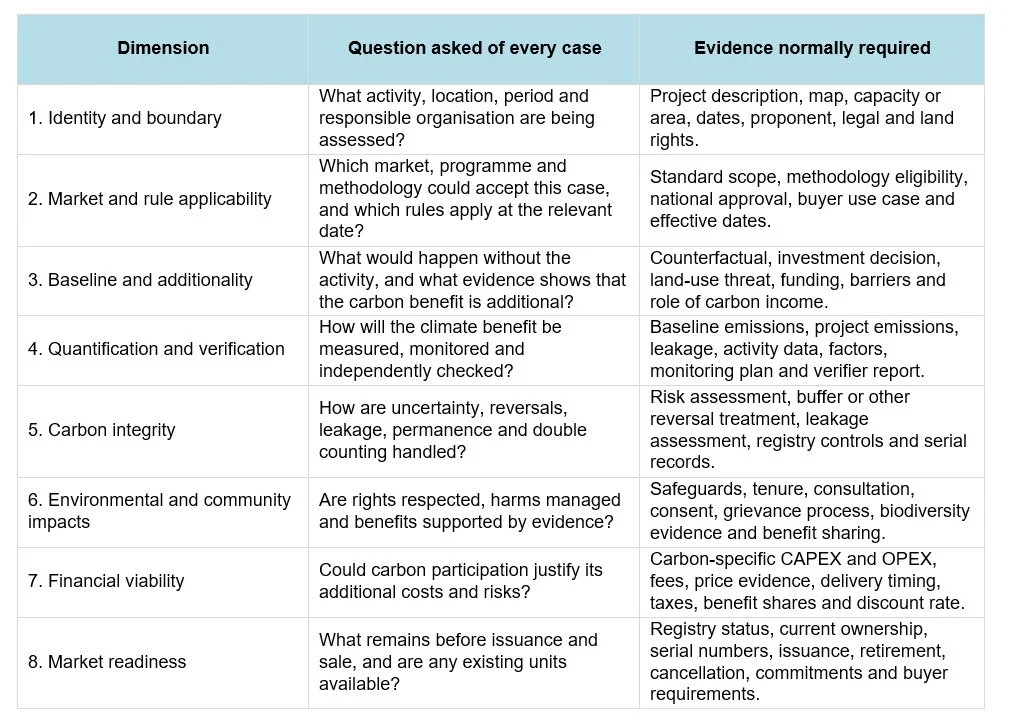
Each dimension is reviewed using four items: the evidence found, the finding supported by that evidence, the information that remains unestablished, and the decision affected by the gap. The assessment uses a qualitative judgement. It does not add scores that could hide a critical eligibility failure behind a strong result in another category.
2.2 The eight common dimensions
2.3 Evidence and source hierarchy
The assessment prioritises primary and traceable sources. The main evidence includes the World Bank and LEC draft ESIA and the Verra VCS Standard for Saint Paul 2; peer-reviewed peatland studies and UNEP/GEF project material for Cuvette Centrale; and the AENOR verification report, Verra–Indonesia agreement and Climate Active disclosure for Rimba Raya. The ICVCM Core Carbon Principles provide a common integrity lens.
2.4 Assessment sequence
The same sequence is followed for each case.
Define the case. Set the activity, boundary, location, period and responsible organisation used in the assessment.
Test the route. Check the market programme, methodology scope, national process and buyer use case before making a financial claim.
Test the baseline. Describe the without-case and identify the evidence needed to show additionality.
Quantify the benefit. Use the selected methodology to separate baseline emissions, project emissions, leakage and approved deductions.
Review integrity. Check uncertainty, reversal risk, permanence, double counting and the relevant buffer or risk treatment.
Review safeguards. Check rights, consultation, consent, grievance arrangements, biodiversity and benefit sharing.
Review financial viability. Model the additional carbon cash flows only when route, credit schedule, costs, prices and timing are supported by evidence.
Review market readiness. Separate historical issuance, retirement and current saleable inventory, then state the next action.
2.5 Calculations and missing data
The general quantification relationship is: credits equal baseline emissions minus project emissions minus leakage and other deductions required by the selected methodology. The relationship is a framework for the calculation. It does not make an input eligible or convert a published comparison into credits.
For Saint Paul 2, the reviewed ESIA gives 1,027 GWh of indicative annual generation and a fossil electricity factor of 778 gCO₂e/kWh. Reproducing the source comparison gives 799,006 tCO₂e per year. This is retained as a transparent arithmetic check only. It is not used as a credit forecast because the eligible baseline, project emissions, leakage and route have not been established.
For Cuvette Centrale, 29.0 PgC is converted to approximately 106.33 billion tCO₂e equivalent only to show the unit relationship. It remains a regional stock estimate. It is not multiplied by a carbon price and is not treated as annual issuance.
For Rimba Raya, the assessment retains the AENOR stated total of 6,890,938 net issuable VCUs for the 2017–2019 monitoring period. A simple subtraction of the stated buffer from the stated net reductions gives a different number because the methodology includes additional calculation and uncertainty treatment. The source result is therefore kept, while the simple subtraction is recorded only as an audit check.
Missing information is not replaced with zero. Historical verified units are not treated as current inventory. Regional carbon stock is not treated as a project credit volume. Related programme funding is not treated as project CAPEX. Earlier training assumptions for price, discount rate, credits and costs are excluded from the case analysis.
2.6 Comparison rule and limits
The comparison is based on evidence strength, route risk, project-definition quality, data readiness and the next decision that the evidence supports. Raw tonnes, hectares or historical units are not used as a common score. This prevents the largest number from appearing to be the strongest commercial opportunity.
The method has three important limits. First, the cases are not equally mature. Second, the review uses public sources and does not replace legal, technical, validation or verification work. Third, current ownership and saleable inventory require live registry and transaction evidence that was not established for all three cases. The conclusions should therefore be read as a defensible screening recommendation and a work sequence for the next assessment stage.
3. Case Assessments
3.1 Saint Paul 2 hydropower case
The Saint Paul 2 case is the earliest-stage engineering case in the comparison. The public material is a draft early-works ESIA for a proposed main scheme. It provides enough information for a market-route screen and a transparent reproduction of one emissions comparison. It does not provide enough information for a carbon-credit forecast or an incremental carbon NPV.
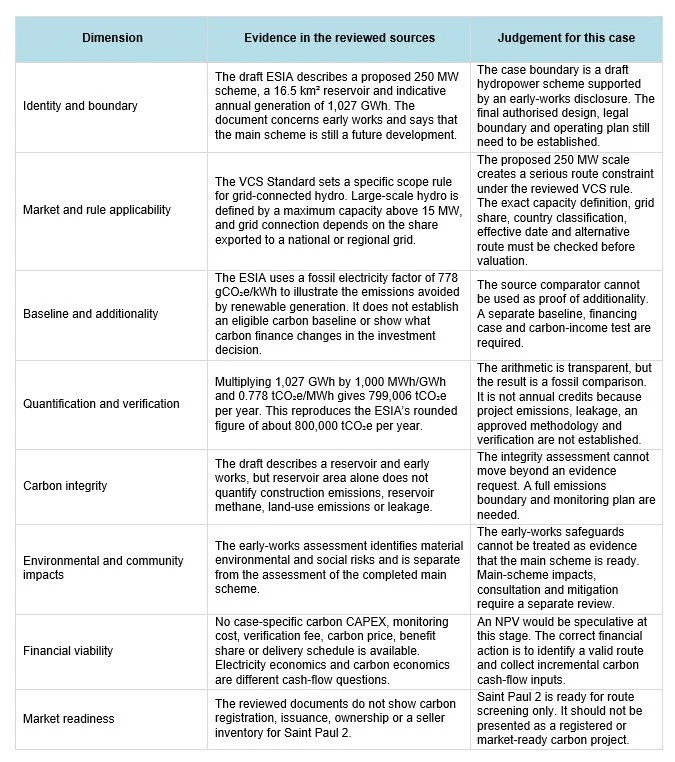
The public evidence supports a route-first decision. Saint Paul 2 could become the clearest case for an integrated financial model if an eligible crediting route is found, because a hydropower case already has an operating and electricity-revenue logic. That conclusion is conditional on the route test; the current evidence does not support a carbon valuation.
3.2 Cuvette Centrale peatland case
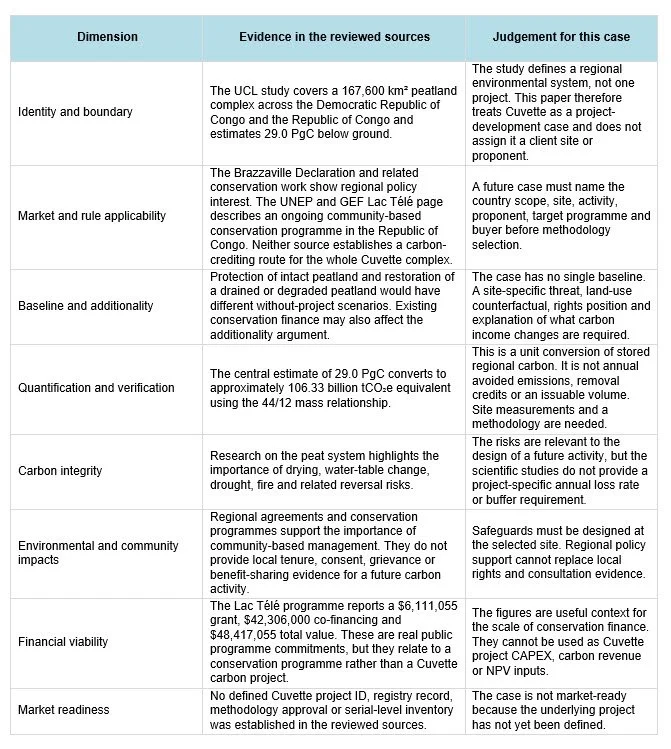
The Cuvette Centrale case is a regional scientific and conservation case rather than a defined carbon project. The public evidence is strong on the existence and scale of the peatland complex. It is weak on the information required to turn that regional context into one crediting activity. The central task is therefore project definition.
Rimba is the most useful benchmark for the evidence structure of a carbon case. It has the strongest historical verification record, but it should not be called a current market-ready inventory until current status and ownership are checked.
4. Cross-Case Comparison
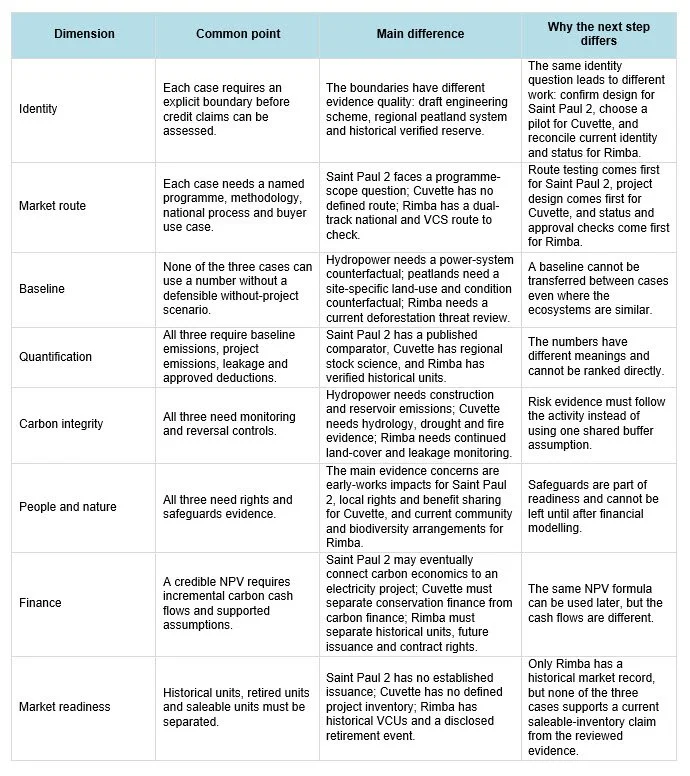
The common model produces a comparable decision view, but the cases do not reach the same decision from the same evidence. Saint Paul 2 is mainly a route-screening case. Cuvette is mainly a project-definition case. Rimba is mainly a historical benchmark and current-status reconciliation case.
4.1 Common points and important differences
4.2 Main obstacles and their causes
Saint Paul 2: The main obstacle is route eligibility. The case has enough public engineering information to reproduce an emissions comparison, but the proposed scale and grid-connected hydro rules may prevent the proposed route. The cause is a mismatch between the engineering description and the eligibility conditions of the chosen programme.
Cuvette Centrale: The main obstacle is the absence of a defined project. The science describes a very large and important peatland system, but it does not identify one intervention, one boundary, one proponent or one counterfactual. The cause is a difference between regional scientific evidence and project-level carbon accounting.
Rimba Raya: The main obstacle is the gap between historical verification and current market status. The case has a strong historical evidence pack, but the reviewed material does not establish current ownership, available serials or future issuance. The cause is the time gap between the verified monitoring period and the present market position.
4.3 Why the cases require different treatment
The cases require different treatment because the common model compares decision questions, while the underlying evidence follows the activity and the stage of development. Applying one formula or one score to all three would create false comparability.
For Saint Paul 2, the logical order is route eligibility, final design, baseline and monitoring, then carbon cash flows. For Cuvette, the order is site selection, activity definition, rights and current condition, then methodology and quantification. For Rimba, the order is identity reconciliation, current legal and registry status, ownership and updated verification, then future issuance or inventory analysis.
This difference does not weaken the common model. It shows why the model is useful. It keeps the questions stable while allowing the evidence request, calculation and recommendation to change. The final comparison is therefore a comparison of readiness and next action, rather than a comparison of the largest number of tonnes.
5. Recommendations
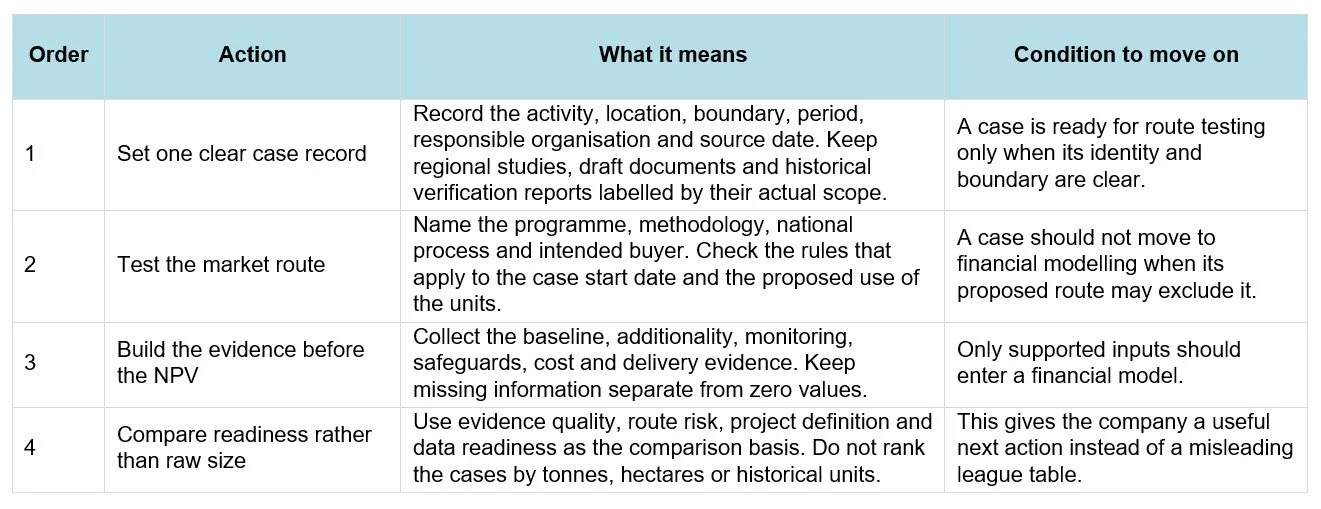
The comparison does not support choosing one case as the winner. The cases need different next steps because the main gap is different in each one. The company should improve the evidence and route decision before asking for a full financial comparison.
5.1 What the company should do first
The company should use the common model as an early screening process. The first stage should answer three questions for every case: what exactly is being assessed, which market route could apply, and what evidence is still missing. Detailed price, cost and NPV work should start only after those questions have a supported answer.
5.2 Saint Paul 2 next steps
Saint Paul 2 should be treated as a route-screening case. The draft ESIA provides enough information to reproduce its fossil-emissions comparison, but it does not establish a carbon-credit route or a carbon cash-flow case.
First, name the programme and buyer that the case is being tested against. Then check the hydro eligibility rule using the final authorised capacity, the share of generation exported to the grid, the country classification and the rule effective date.
Next, obtain the final main-scheme design, legal boundary, main-scheme environmental and social documents, financing information and the evidence needed for an eligible baseline and additionality claim.
Only after those checks, build the incremental carbon NPV. Electricity revenue should remain in the wider hydropower model, while carbon income should be modelled as the additional cash flow caused by carbon participation.
The case should move forward only if a suitable route and baseline can be supported. If the route does not accept the case, further carbon valuation would not be useful.
5.3 Cuvette Centrale next steps
Cuvette Centrale should be treated as a project-definition case. The regional study is important evidence about peatland scale and carbon storage, but it does not identify a project that can issue credits.
First, choose one site, one activity and one responsible organisation. The paper should state whether the activity is protection of intact peatland, restoration of degraded peatland, or another defined intervention.
Next, map land and community rights, current condition, water levels, fire risk, land-use pressure and the without-project scenario. Decide whether one country scope is sufficient or whether a cross-border structure is actually needed.
Only after those steps, choose the methodology and design the monitoring plan. The regional 29.0 PgC figure should remain background evidence and should not be used as a credit forecast or NPV input.
The case should move forward when the site, activity, proponent, rights and counterfactual are clear. Until then, the right output is a defined pilot request rather than a credit-volume estimate.
5.4 Rimba Raya next steps
Rimba Raya should be used as a historical benchmark and an evidence checklist. It has the strongest historical verification record, but the reviewed material does not prove a current balance that can be sold.
First, record the case as Indonesia and resolve the Malaysia label in the source record. Then obtain the current Verra and Indonesian registry position, the current legal and ownership documents, and the latest verification information.
Next, separate historical verified units, retired units, future issuance and units controlled by a current seller. Confirm any commitments, cancellations and serial-level records before discussing inventory or price.
Only after that, model future issuance or existing-unit sales as separate cases. Do not use the historical 2017–2019 verified quantity as a current supply number.
The case should move forward when identity, ownership and current registry status are supported by current records. Its value for the present comparison is mainly the structure of its historical evidence pack and the checks it suggests for the Cuvette case.
5.5 Overall recommendation
The company should work in this order: screen Saint Paul 2 for an eligible route, confirm the current identity and status of Rimba Raya, and define one Cuvette pilot. This order reflects the main evidence gaps. It does not mean that Saint Paul 2 is already the best investment opportunity or that Rimba Raya has current credits for sale.
Once the main evidence has been collected, the company can collect comparable cost and price inputs and run low, base and high scenarios. Until then, a single price, discount rate or NPV would give a level of certainty that the current evidence cannot support.
6. Limitations and Conclusion
6.1 Evidence limitations
This study uses public sources. The sources are not equal in type or date. Saint Paul 2 is assessed mainly through a draft early-works disclosure. Cuvette is assessed through regional scientific studies and related conservation programme information. Rimba Raya is assessed through a historical verification report and later public status information. These sources support different types of statements.
The review did not establish private contracts, live ownership records for all units, complete transaction prices, project-level carbon costs, final design documents for Saint Paul 2, or a defined Cuvette project. It also did not establish a current saleable inventory for any of the three cases. A source-backed number can still be historical, regional or indicative. It should be used within the scope of the source that reports it.
6.2 Scope and limits of the framework
The common model is suitable for early screening and for comparing what evidence is needed next. It is not a certification decision, a legal opinion, a validation or verification report, or an investment recommendation. It does not replace the methodology-specific calculation required by a registry or the due diligence required by a buyer or financier.
The model is most useful when it keeps the same questions while allowing the evidence request to change with the activity. It becomes less useful if a reader treats the eight dimensions as a scorecard, transfers a baseline between cases, or fills missing inputs with assumed values.
6.3 Answers to the research questions
6.4 What we know and what we still cannot judge
6.5 Conclusion
This comparison does not produce one winner. It produces a clearer work order. Saint Paul 2 needs a route decision. Cuvette needs a defined project. Rimba Raya needs a current status and ownership check.
That result is still useful for the company. It shows why the same assessment questions can lead to different recommendations. It also prevents large regional carbon stocks, published comparison figures and historical verified units from being treated as equivalent commercial assets.
Once the required evidence is obtained, the common model can be updated with a methodology-specific credit calculation and a transparent scenario NPV. Until then, the most reliable recommendation is to improve the evidence before making a financial ranking.